
The Handkerchief Tree
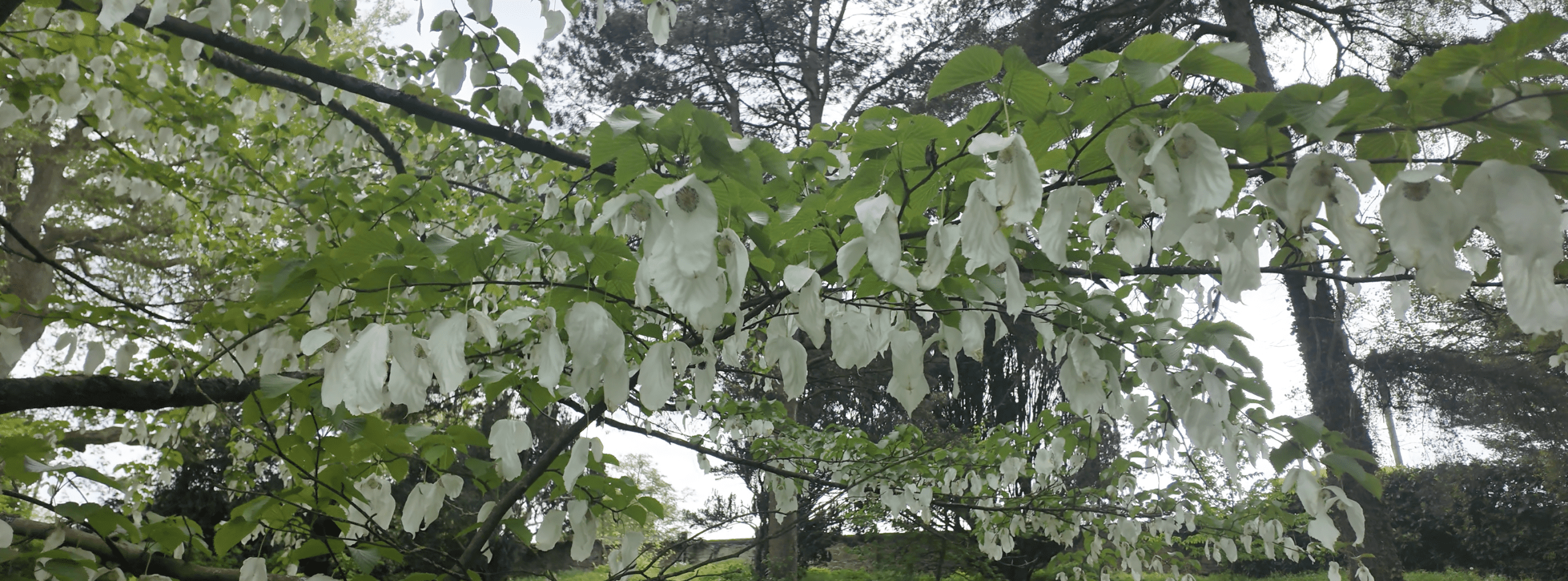
A handkerchief tree in bloom is one of the most stunning things you can see. It was first discovered in Baoxing near the Tibetan border around 1869 by Father Armand David, a French Catholic missionary.
David, incidentally, was also the first European to encounter giant pandas – or at least the body of one – and gave his name to a species of deer. He sent dried specimens of the handkerchief tree back to Paris, leading to it being named after him, Davidia involucrata.

The tree was spotted again 20 years later by an Irish doctor and plant hunter Augustine Henry. He again found just a single tree – this time in the Yangtse Ichang gorges. He described it as one of the strangest sights.
“… a solitary tree of Davidia in full blow… waving its innumerable ghost handkerchiefs.”
Ernest “Chinese” Wilson
In 1899 the great Veitch nursery offered a 23-year-old botanist from the Birmingham Botanical Gardens £200 to go to China on a three-year contract just to collect seeds of the tree. “Do not dissipate time, energy, or money on anything else,” barked his instructions.
Ernest Henry “Chinese” Wilson was to become one of the great plant hunters of his time, making four major expeditions to China and spending 11 years there. But first he had to make his name by finding that tree. And to do that, he needed to find Henry.

As he landed in Hong Kong it was “suffering from its usual visitation of bubonic plague”. It meant he couldn’t pick up a translator but managed without for a while, travelling west first through Vietnam venturing north by steamer to the Chinese border and crossing into Yunnan province.
On 18th August a young man approached him with a letter of introduction as a translator. “He was a Chinese of very unprepossessing appearance who smoked opium freely and had been discharged from the Telegraph service for incompetency, but he spoke a little English. I engaged him on the spot…”

Danger
They travelled to Simao, close to the Indo-China border, to meet Henry, who was still plant collecting in China. The generous botanist drew a map, showing Wilson exactly where to find the village close to where he had seen the handkerchief tree.
“The place was among high mountains in the sparsely populated region bordering the provinces of Hupeh and Szechuan and south of the mighty Yangtsze River.”
It took him eight months to get there and almost at the end he had to turn back. He was to pass through an area where only a couple of years earlier there had been rioting between anti-Christian and Christian villagers that had cost hundreds of lives. “Whole villages had been burnt to the ground, and a Roman Catholic priest – Père Victorin – brutally murdered and his corpse barbarously mutilated.” Trouble was still simmering. He defied the warnings and carried on with an armed guard.
Joy and despair
On the afternoon of 15th April 1900 Wilson arrived in the hamlet of Ma-huang-po and the house where Henry had stayed when he discovered the tree. He asked locals if they knew of it and was pleased when they said they did.
He asked if someone would guide him to the tree. “Certainly!” they replied. Things were looking promising. He later wrote:
“We sallied forth, I in the highest of spirits. After walking about two miles we came to a house rather new in appearance.”
That may have set the warning bells ringing. A few yards on they found the stump of Henry’s Davidia.
“The tree had been cut down a year before and the trunk and branches formed the beams and posts of the house! I did not sleep during the night of April 25, 1900.”
You can feel his agony, can’t you? Pass that man a handkerchief! His luck was to change a few weeks later.
“On May 19th, when collecting near the hamlet of Ta-wan, distant some five days southwest of Ichang, I suddenly happened upon a Davidia tree in full flower! It was about fifty feet tall, in outline pyramidal, and with its wealth of blossoms was more beautiful than words can portray…Now with a wider knowledge of floral treasures of the Northern Hemisphere, I am convinced that Davidia involucrata is the most interesting and most beautiful of all trees which grow in the north temperate regions.”
Doves and bracts
The handkerchiefs on the tree are not flowers but two large white bracts – leaves that act as an umbrella, which scientists believe may be to protect the pollen from the rain. Wilson wrote of them:
“When stirred by the slightest breeze they resemble huge butterflies or small doves hovering among the trees.”
The tree is often also known as the dove tree. Chinese mythology says that during the Han dynasty (202 BC to 220 AD) a beautiful Chinese princess was married off to the king of a northern tribe and despatched 1,000 miles to live with him. She would send letters home to her family attached to doves, which would land on this tree.
Wilson later found other Davidias in the region and had them carefully watched. In November he returned to harvest the walnut-like fruit containing the precious seeds. He sent them to England where they arrived in 1901. He followed home himself in 1902, jubilant. And then he learned the bad news.
Frustration
“I had yet one little cup of bitterness to drain. Monsieur Maurice de Vilmorin had received seeds of the Davidia from a Roman Catholic Missionary, Père Farges, in 1897, and in 1898, one plant was raised in his arboretum at Les Barres, France. From this plant two or three cuttings and one layer were rooted. A rooted cutting was sent to Kew Gardens, another to the Jardin des Plantes in Paris, and the rooted layer to the Arnold Arboretum, where it is now growing freely. My employers were aware of this soon after I had been dispatched to China in 1899, but I was not, and I took my draught when the whole story was published by Monsieur Andre in the Revue Horticole, August 16, 1902, p377.”
Once again his frustration is tangible – you can tell by him citing the exact edition and page the news can be found. The article in the French journal explains how Farges had sent back 40 Davidia fruits but only one actually germinated. It was enough. That tree flowered for the first time in May 1906 – a smooth-leaved variety of the tree, Davidia involucrata vilmoriniana.
More than 13,000 of the Davidia seeds Wilson sent home geminated. But it is the French tree – more hardy – that is now most widely cultivated in Britain. Wilson’s trip was not a failure, though. Despite his instructions to concentrate only on the Davidia, he brought home seeds of more than 300 other plants and 35 Wardian cases of bulbs, tubers, corms and rhizomes. Many of these were to be successfully introduced by Veitch. His name was established and our gardens are richer for his discoveries.
We will hear more of Wilson’s adventures another time. There is much more to tell!
Melbourne Hall
In May you can see a beautiful sample of the handkerchief tree at Melbourne Hall in Derbyshire. It is a favourite of Head Gardener David James, though he complains that it often deceives him. Those bracts don’t just look like handkerchiefs on the branch.
“They continue to look like handkerchiefs on the floor as well. bracts look like handkerchiefs even when they’ve fallen. I often come through thinking: ‘Oh! Someone’s dropped a tissue again!”

While they are still on the tree, though, they are a sight to behold.