
Caroline Francklin – The rose looking in at the window

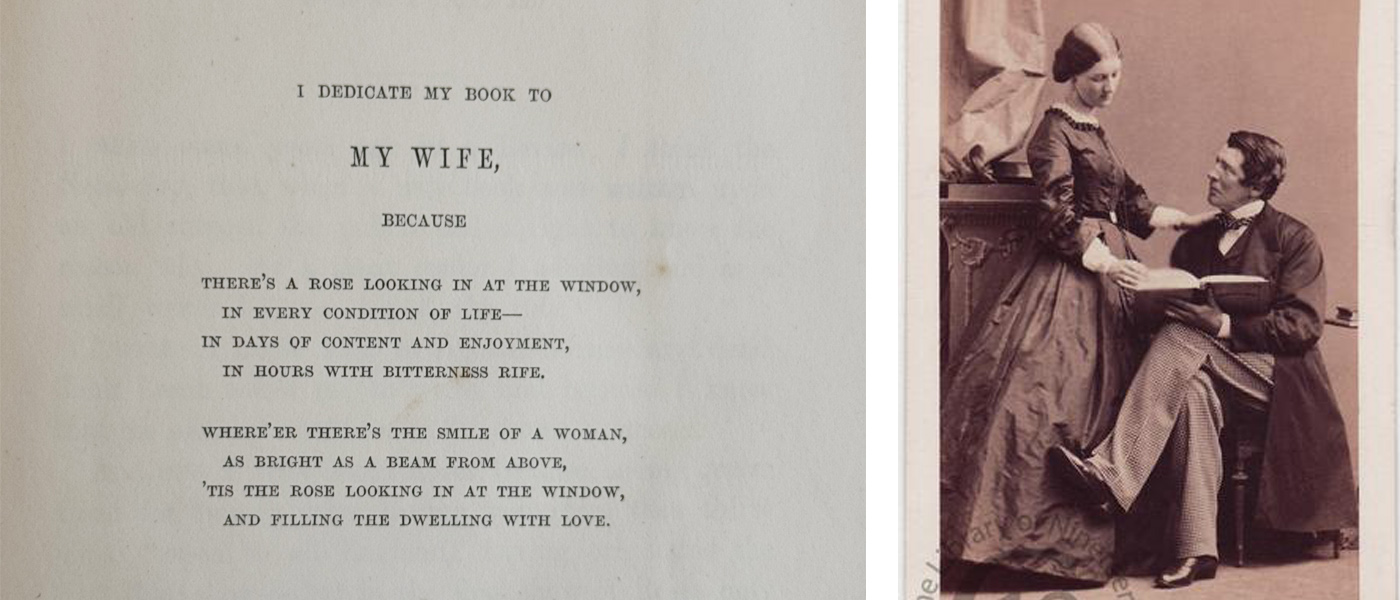
One of the most successful books ever written on the rose is A book about roses by Samuel Reynolds Hole, first published in 1869. It starts with a romantic dedication to his wife, Caroline – the rose looking in at his window.
There’s a rose looking in at the window
In every condition of life
In days of content and enjoyment,
In hours with bitterness rife.Where’er there’s the smile of a true wife,
As bright as a beam from above,
‘Tis the rose looking in at the window,
And filling the dwelling with love.
Hole was a Nottinghamshire vicar who launched the first national rose show and was the founding president of the UK Rose Society. He played a major role in making the rose the most popular of blooms. But the man who Tennyson called “The Rose King” was rather slow in finding a queen.
First love
It was not that he never fell in love. Hole acknowledged: “I really cannot remember any period in which I was not in love with somebody; and I recall affecting verses which I wrote soon after I had entered on ‘the teens’…
“When first I saw the golden curls
Of William Barlow’s youngest sister,
I loved her most of all the girls,
And more and more I sadly miss’d her
And though Bill Barlow, when I praised,
And told him that I loved his sister,
Came at me with a stick, and raised
Upon my arm a horrid blister
And though I struck him on the nose,
I still adored his youngest sister;
And after that exchange of blows,
More madly for my wife I wished her…
And it was Christmas-time, you know,
And she was kind, that youngest sister;
And so, beneath the mistletoe,
I offered her my hand – and –[Here the manuscript is illegible]”
At the age of 38, Hole went on a tour of Ireland with the brilliant Punch artist John Leech. Leech is most famous today for doing the original drawings for Dickens’s Christmas Carol. He and Hole were firm friends and produced a book on the back of their holiday. Leech provided the illustrations, Hole the text. There may have been an element of autobiography in it.
A little tour of Ireland
The premise for the trip was that Hole (who played the character Philip) was lovesick having had a marriage proposal turned down. Leech, in the guise of ‘Frank’, was taking him out of himself. Let’s just say that Philip seemed to get over his rejection quickly. Before he’d even left England in fact…
“I fell violently in love at Crewe station, whence my heart was borne away, in the direction of Derby, by the loveliest girl, that is to say, one of the loveliest girls, that ever beautified an express train.”
On the ferry he found another
“Her very bonnet deserves a sonnet,
And I’d write one on it If I’d the time
But something fairer and dear and rarer
In coorse, the wearer, shall have my rhyme”
Caroline Francklin
In 1861 Hole met Caroline Francklin from Gonalston in Nottinghamshire at an archery meeting. Hole was a first-class archer. One of his party tricks was to put a lighted candle in the centre of the target and from a distance of 60 yards fire arrows effortlessly into it. Francklin was a fine archer herself. He fell deeply, and finally, in love, deciding to propose to her a few months later. He wrote to his sister Sara in New Zealand.
“After prowling about the hen roost for ‘many roving years’, I have made selection of a beautiful pullet and intend to carry her off. Wish the old fox success… I have found, and have wooed, and have won, such a sweet, bright, gentle lady.”
Hole told his sister how he was “entirely spifflicated” by Caroline’s condescension to accept his proposal. There was one small matter – Miss Francklin was only 20. He was 42. He admitted: “She is rather young. I have spoken to her seriously about this delinquency, and note improvement.”
“[She is] ‘a daughter of the gods, divinely fair, and most divinely tall’ for she is 5 feet 8 inches in height, fair with much roseate glow.”

Marriage
They married on May 23rd 1861. It was a happy and successful marriage. They had one child – Hugh. Hole would write to “Carry” regularly whenever he was away. There’s a lovely little note sent during one of his absences long after they’d been married: “I have written one hundred letters this week and this is about the only one which has been a pleasure… I am still, after fourteen years of affliction, borne patiently, your loving husband, Reynolds.”
In my own collection I have a letter he wrote to her in January 1865. It starts “I immensely enjoyed my sweet darling’s note this morning.” And ends with: “your hurrying husband”. It is signed “Trim”. Maybe it was her nickname for him. He would call his son “Tweets” in letters, and her “Tweet of the tweetiest”.
Rochester
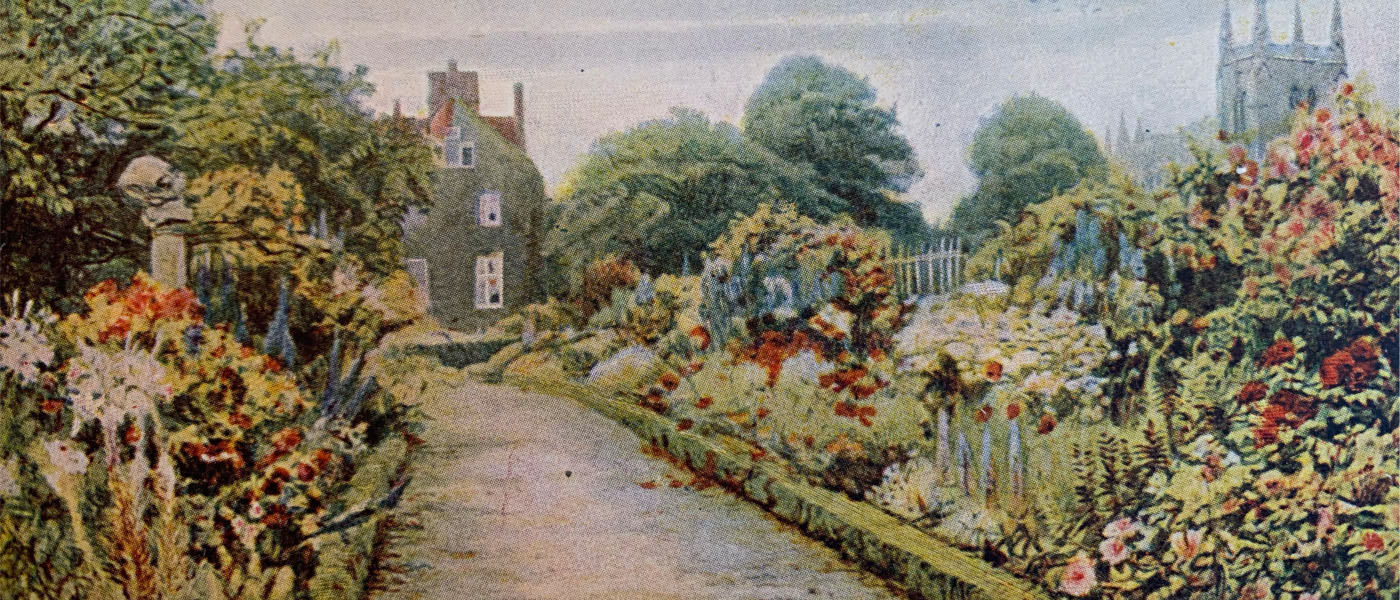
For much of his working life Hole was vicar of Caunton but in 1887 he was made Dean of Rochester. He was 68. It was an enormous upheaval for him and Caroline to leave Caunton and his thousands of roses there to decamp to Rochester. It can’t have been easy at the time. Rochester was an industrious place, full of smoke and there was a stinking cement works up the road.
The Holes always lived to the limits of their means. The 1881 census at Caunton shows they had a butler, coachman, ladies’ maid cook housemaid and kitchen maid and there was at least one gardener on top of this. Hole’s salary at Caunton was £200 a year. Caroline learned how to stretch the budget and one of her tricks was to keep pigs, whose manure also helped with the garden. Hole’s salary rose to £2,000 a year at Rochester, but she brought some of her pigs with her still. Perhaps because she had a tame piglet called Ianthe, who followed her about like a dog, she became known as authority on the animal. “What is the matter with these people?” she asked in exasperation soon after their arrival. “They think I can only talk about pigs!”
Caroline did much of the work creating their garden at Rochester, with the encouragement of two friends who knew as much as anyone about gardening – William Robinson and Gertrude Jekyll. Robinson named a pink carnation “Mrs Reynolds Hole” after her. The artist Sir Herbert Oliver painted a portrait of her holding the flower. Jekyll, singing the praises of Reynolds Hole, was careful to include Caroline. “The Dean is not alone among the flowers, for Mrs Hole is also one of the best of gardeners.”
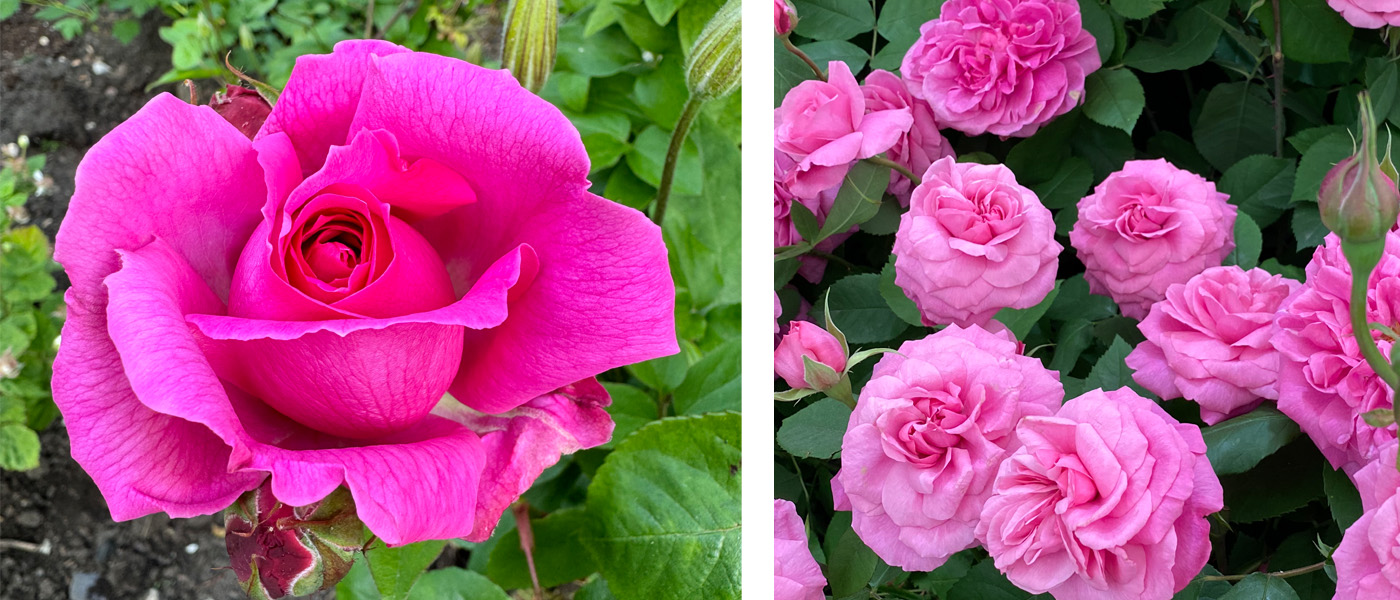
‘Mrs Reynolds Hole’
In 1900 French breeder Nabonnand named a lovely deep pink tea rose after her – again, ‘Mrs Reynolds Hole’. You can still buy it. In my garden it sits across the lawn from the David Austin rose, ‘Gertrude Jekyll’. I am sometimes tempted to lay a table with cups and saucers for the two friends.
Hole was 83 when he died in 1904. Caroline lived another 12 years and was a Vice-Patroness of the National Rose Society. She died in Hawkshurst, Kent in February 1916 and was buried alongside her husband in the graveyard of the parish church at Caunton where they had spent the early part of their married life. Their love of gardening was something that bound them together over many happy years. She was, indeed, the rose looking in at the window.
Banner image: A painting of Caroline Hole with the carnation that was named after her.