
The world’s oldest gooseberry show
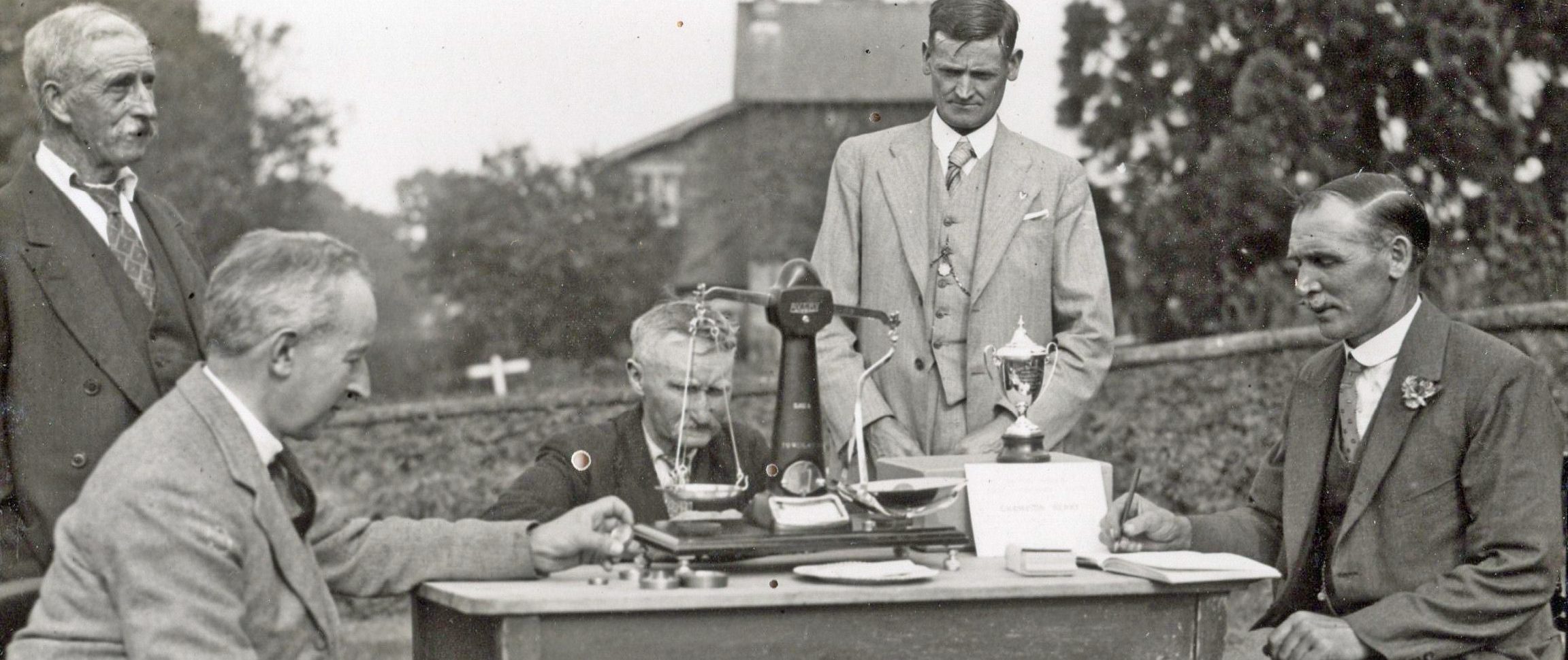
For nearly 300 years gardeners in the North of England have been getting their gooseberries out each August to see who has the biggest. This year the world record has been broken. But more of that shortly.

In the early days the prizes may not have sounded lucrative – a pair of blankets, a tea pot or “a piece of cloth” – but growers were motivated by the competition. Enough, sometimes, to cheat.
Legitimate tactics involved thinning the crop to just two or three berries on a branch, shading the berries from the hot sun and rain in June and July, and feeding them liberally.
My copy of The Library of Agricultural and Horticultural Knowledge from 1830 recommends “manure water”. It helpfully offers a recipe for those of us who wish we had bigger berries.
“The water which we use is three quarts of drainings from a dunghill, to one quart drained from fowls’ or pigeon’s dung, soaked for the purpose, which must be applied so as to keep the soil in a moist condition.”
Suckling the gooseberry
Those who found even this insufficient might resort to the practice of “suckling the gooseberry”. This entailed putting a cup under the berry so that the bottom quarter rested in water to swell. Devious!
My own gooseberry bush…. correction, gooseberry tree (serious growers insist it is not a bush)… is ‘Crown Bob’. This is a red variety that dates to 1805 – maybe earlier. It won first prize in its category at a show held at the Salutation pub here in Nottingham in July 1819. The prize berry weighted in at about 19 pennyweights and 19 grains – about 30 grammes. (‘Troy’ weights were typically used on the scales – 24 grains to one pennyweight, 20 pennyweights to an ounce. And there were four categories of gooseberry – red, white, yellow and green.)
 The world’s longest running gooseberry show is at Egton Bridge in North Yorkshire. It’s held on the first Tuesday of August each year. It typically attracts around 50 growers and 1500 visitors. You can imagine my pleasure to discover that the Society Secretary is an old roommate from university who I haven’t seen in decades.
Egton Bridge Old Gooseberry Society
Ian Woodcock is the font of all knowledge about the Egton Bridge Old Gooseberry Society. He says: “We can date it back to 1800, though we have found a report in the Whitby Gazette – that bastion of journalism – that reckons it was going in 1755, but we can’t back that up.
“There used to be about 180 shows listed around the north of England. The numbers peaked in the mid 1800s and then declined, especially after the First World War. Now there’s just us and seven in Cheshire.”

The Egton Bridge Old Gooseberry Society’s chairman, Graeme Watson, is the world record holder. In 2019 his best gooseberry weighed in at 36 pennyweights and 12 grains. That’s 64.83 grammes – the size of a hen’s egg! But this year he’s done even better. Subject to verification by the Guinness World Records, he’s broken his own world record with a yellow Millennium berry weighing 65.5g.

To get close to that you need tonnes of dedication as well as liquid manure, says Ian. “It requires lots of feeding, lots of careful pruning and thinning out – you want a tree with just four stems and by the peak you’ll have just four berries on it. People put umbrellas over them so they get just the right amount of water and sun. They’re constantly moving the umbrellas around. I’m too busy working for that, which is why I’m hopeless. But it’s amazing when they come to the weighing station and open up their padded box. And there they are – these bloody big things!”

Size doesn’t affect flavour
Ian insists that size doesn’t affect the flavour. What matters most is ripeness. “People say they don’t like gooseberries because they’re sour. That’s because they’re eating them too soon. The problem with gooseberries is that they go from not ripe to overripe in just two or three days, which is why supermarkets won’t touch them. And they’re difficult to pick.”

“Too true. My‘Crown Bob’ is a spiky blighter!” I grumble.
Ian laughs. “You look like you’ve replayed the Battle of the Somme after you’ve harvested the crop, don’t you? There’s blood everywhere!”
Modern varieties have been bred to be less vicious and more disease-resistant, but their names don’t carry the same weight of history and aren’t as much fun.
Ian adds: “There’s ‘Hero of the Nile’ from around 1799. ‘Edith Cavell’, named after the nurse in the First World War, and ‘Lord Kitchener’. These still do well. The names reflect the time they were bred. And then you get ones like ‘Roaring Lion’.”

It’s fun going through old gardening magazines finding the champions of yore. My favourites are ‘Thumper’, ‘Lumper’, ‘Banger’, ‘Thunder’ and ‘Lightning’. The challenge now is seeing which might still be grown today. Well, that and how much bigger I can make my ‘Crown Bobs’ grow. Maybe next year I’ll compete. I’ve got the umbrella; I just need a dunghill.
