
Amelanchier
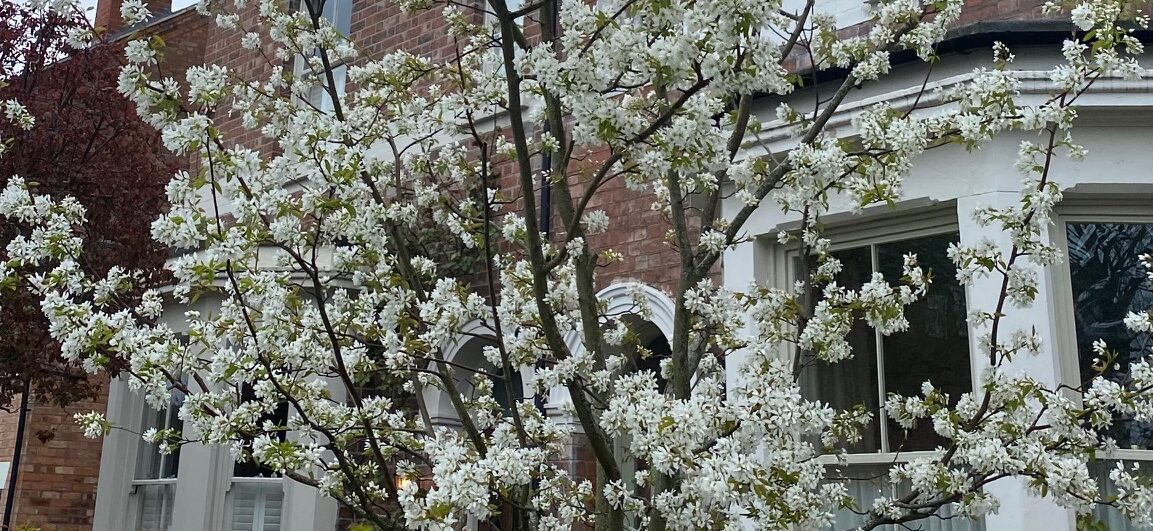
It’s June and the pigeons are flapping like mad outside the bedroom window. They have found the berries on the amelanchier tree in the front garden. And now I have too! This is a fight to the end – the battle of the Snowy Juneberry!
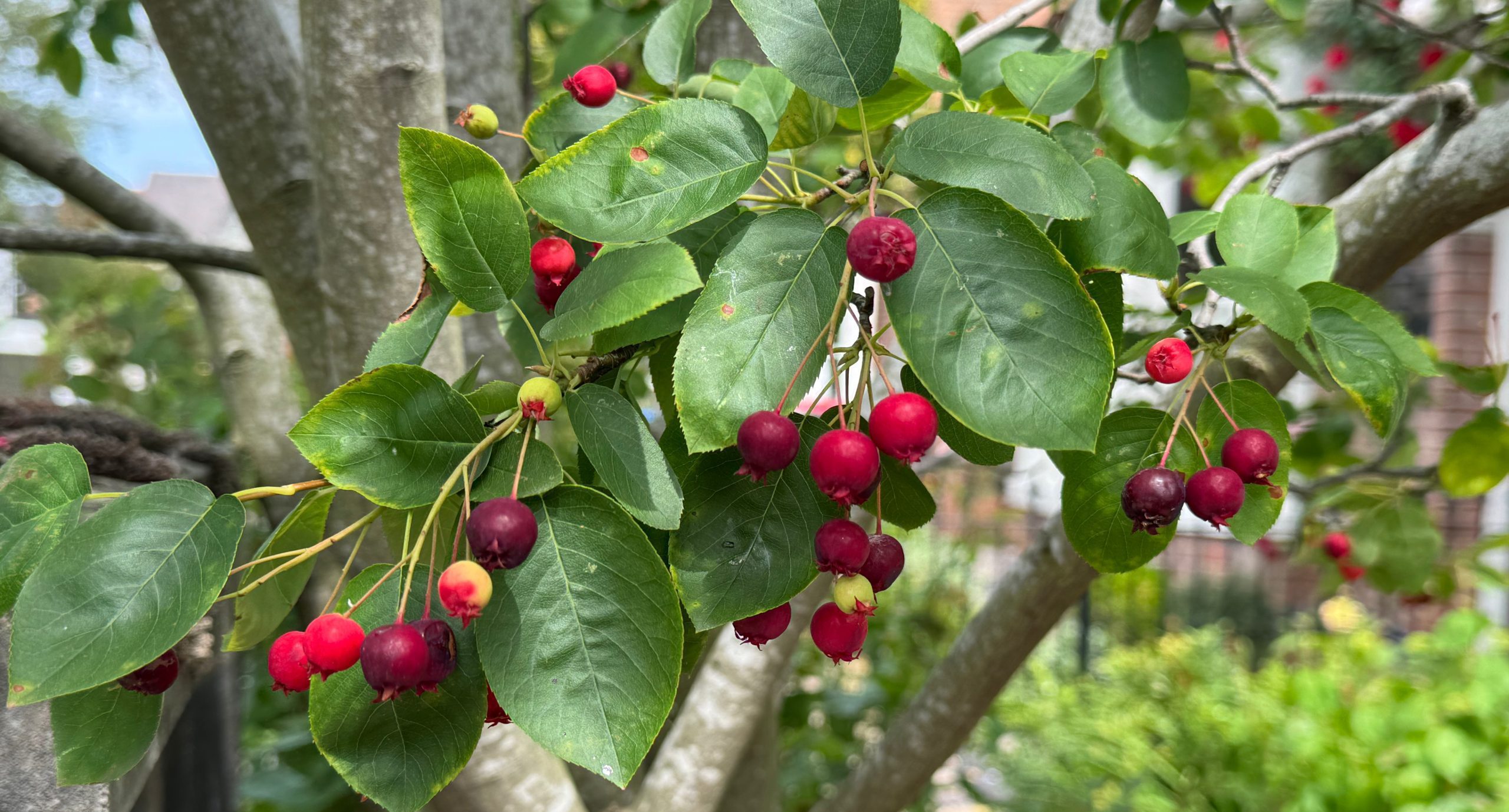
As soon as I finish tapping I’m going out there with a ladder and bowl to harvest as many as I can reach. We’ve had the tree for three or four years but this is the first time I’ve discovered the berries. Somehow they’d always disappeared before I got chance to try them. And who eats berries off trees, anyway? They might be poisonous!
Only these aren’t. They’re delicious, if a bit seedy. They’re the size of blueberries, the sweetness of raspberries with a hint of almond. If you have an amelanchier, try them. If you don’t try a neighbour’s. The chances are that they’ll not be eating them, unaware of what they’re missing.
Ideal front garden tree
When you only have a small front garden, choosing the right tree is important. Make the wrong decision and the people buying your house next will get a surveyors’ report fretting about root damage to the foundations. Before then you’ll find those roots lifting your front path, tripping you up with your shopping.
Choose well, though, and research indicates the only thing lifted will be the value of your property. Writing in Hortus[1], Matt Collins, Head Gardener at the Garden Museum in London, claimed that amelanchiers now represent 90% of trees being planted in ‘stylish’ London front gardens. He told of his quest to find an alternative.

It took him some effort because amelanchiers are quite special. They flower profusely in spring – delicate white stars that almost glow when they hit peak power. The leaves on our tree start out lime green with a hint of bronze. They redden in autumn, before they drop.
In between come the berries. In North America, where more varieties are found than anywhere else, they were a source of vitamin C for native Americans and the early settlers. The Cree called the berries mis-sask-qua-too-min, which got shortened to saskatoon – today the name of the capital of the Canadian province of Saskatchewan. In Germany and Holland people dried the fruits and used them as currants. They also stewed them or made them into jam.
Common names
In Canada, amelanchiers are often known as shadbushes or shadblow because their flowers bloom (or ‘blow’) just as the shad fish begin making their way back up river.

The tree has a few other common names – snowy Juneberry (well we know where ‘Juneberry’ comes from now!), snowy mespilus and serviceberry. It’s said that serviceberry came from the fact that in the Appalachian mountains the tree came into bloom just as the snow was melting. The roads could finally be cleared sufficiently for travelling preachers to reach communities to carry out wedding and funeral services – the ground also now soft enough for bodies to be buried after the tough winter.
Introduction to Britain
The North American amelanchiers began being introduced to Britain as early as 1597[3]. But they took a long time to become common. A. canadensis was still one of the most expensive trees listed in the catalogue of York nursery Telfords nearly two centuries later, in 1775[4].
I think our tree is an A. lamarckii. Botanists believe it is probably a natural hybrid of A. laevis and either A. arborea or A. canadensis – all from North America. Whether the pairing happened there or in Europe no-one knows.

The French botanist, Jean-Baptiste de Lamarck, first described this variety in 1783. He had seen it growing in Paris. He called the tree Crataegus racemosa. In the 20th century Fred-Günter Schroeder, a German botanist steeped in too much Latin, argued that racemose wasn’t a suitable botanical term for amelanchiers. To go into the reason would risk inflicting death by boredom and I don’t have the professional indemnity insurance for that. Suffice to say, he gave Lamarck’s tree what he called a “nomen novum“. And so, in 1968, he rechristened it A. lamarckii.
Alternatives?
So, there you go. Not the perfect tree for Matt Collins (who finally chose a Crataegus x viridis ‘Winter King’), but great for me. It offers three seasons of interest, what fruit I don’t manage to grab for myself is good for the birds and the roots don’t hurt the house.
This doesn’t mean I don’t understand the point Matt was making – I wouldn’t want the whole street lined with them. I think we’re lucky here. We have a rowan, a cherry and a Cornus kousa. They all give me pleasure and, be sure, they’ll all have their own stories to tell in time. But before I research them, I have a bowl and a ladder and a job to do…

Footnotes
[1] “No more Amelanchiers please: seeking a rival to the perfect small garden tree” – Hortus no.148, Winter 2023
[2] More accurately they are a small “pome” – a technical term for the kind of fruit you find in apples, pears and hawthorns or pyracanthas. See: The Shadbushes, Richard E. Weaver Jr. Arnoldia vol 34 No 1 Jan/Feb 1974
[3] Sarah Rutherford, An Introduction to hardy plants and plantings for Repton and late Georgian gardens (1780-1820) Garden History Spring 2019.
[4] Early Gardening Catalogues by John Harvey p.54