
Cyclamen – a cure for more than just the winter blues
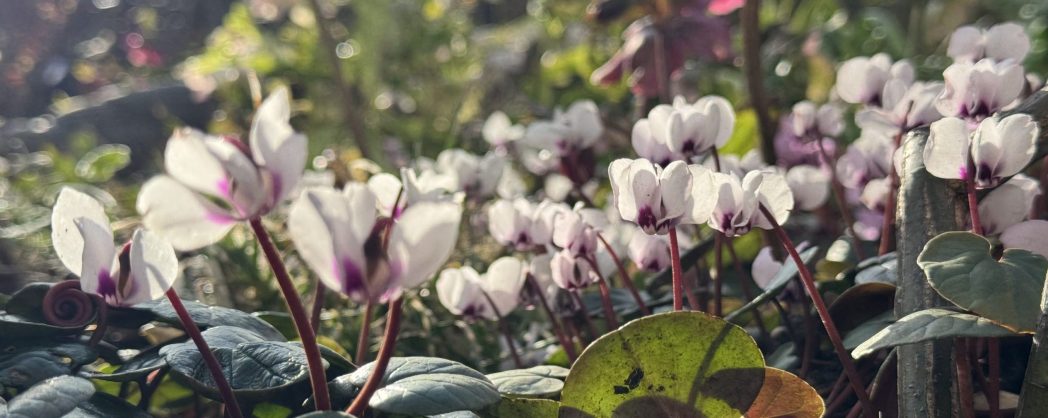
It’s that time of year when the cyclamen and hellebores are in full bloom, bringing a glimmer of hope in the dark dog-end days of winter.
In front of our dining room bi-fold doors we have a deep square flower bed that regular readers of this blog will be unsurprised to find is full of roses. It could be seriously depressing looking out on this bed before May were it not for these two plants.
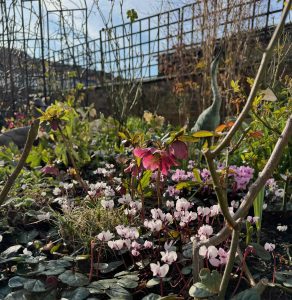
Let’s look at the cyclamen. I can’t recommend them enough. Plant a few bulbs just below the surface, wait patiently and in a few years you’ll have a carpet of bright purple, pink and white flowers to help banish the winter blues. They’re particular useful in a garden because most flourish in shade, making them great under mature trees.
There are 23 different species of cyclamen. Vita Sackville West described Cyclamen hederifolium, as “the little frightened cyclamen, with leveret ears laid back.”[1] Most species are certainly delicate. Therein lies their charm. You do not expect anything so fragile to demonstrate such resilience. So uplifting!
Cyclamen hederifolium

The Autumn-growing cyclamen hederifolium is believed to be native to the UK and mainland Europe. It was grown in Elizabethan knot gardens. It has lovely ivy marbled leaves and was known as “sowbread” or “swinebread” in ancient times. This appears to be a translation of the French ‘pain de porceau’ and may be because in Sicily the roots were said to be enjoyed by wild boar.
The great 19th century rosarian Canon Ellacombe dismissed this. He says he once “had a night-raid on my garden from a family of hungry pigs, and in the morning it was easily seen that they had been grubbing in a bed that had a large number of cyclamens in it, but not a single root was touched by them.”[2]
Cure-all
Cyclamen plants have been used over the centuries to treat a vast range of maladies.
Balding? Fear not, stick some cyclamen up your nostrils. So encouraged a fourth century herbal. I’m not sure how it helps, but it might distract you from worrying about thinning on top. Gerard encourages you to dab some juice of sowbread on your bum to sort piles.
It was seen as offering such potent assistance in abortion or in speeding up childbirth that “it is perilous for weomen with chylde to go ouer this roote”, according to the English cleric. William Turner[3]. Gerard took that advice so seriously he was unusually careful to prevent any pregnant women from accidentally stepping over it[4].
‘I have (about the place where it groweth in my garden) fastened sticks in the ground, and some other sticks I have fastened also cross-ways over them, lest any woman should by lamentable experiment find my words to be true, by their stepping over the same.’ – Gerard 1597.
Aphrodisiac and contraceptive!
Additionally, cyclamen was seen as an aphrodisiac and yet, according to Anna Pavord, was also widely used by women in ancient Greece as a diaphragm-like contraceptive[5]. This was certainly an all-purpose plant! And it doesn’t end there.
Turner said it was a cure for jaundice. Mixed with vinegar it could improve your sight. It was also good for gout, for treating skin conditions and a whole host of complaints that to the 21st century mind sound very strange indeed. Let’s just say I won’t be laying any upon my navel to “softeneth ye belly” (though I might be more tempted if it reduced it).

How they got their name
My cyclamen are cyclamen coum, which originated on the Greek island of Kos. The name ‘cyclamen’ comes from Latin ‘cyclaminos’ and ancient Greek, ‘kyklos’, meaning ‘circle’. This is a reference to their round tuber, but it may also have something to do with the curious way they propagate.
“The botanical interest is chiefly connected with the curious habit of the plant to form its seed-vessel in the usual way, and then for the seed-vessel to hang down and by a succession of coils of its flower-stem to bring the seed-vessel close to the ground, and there to bury it… there is little doubt that the name of the plant was derived from this coiling habit.” – Canon Ellacombe
If the flower has been pollinated, the seed capsule splits open on maturity. The seeds inside are sugary and get carried away by ants and other foraging insects, helping to spread them. Long may this continue. The more the merrier as far as I’m concerned. They may be an ancient apothecary’s cure-all but I’m happy to use them today just to treat the winter blues.

[1] Vita Sackville-West, The Garden
[2] Canon Ellacombe, In a Gloucestershire Garden
[3] Turner’s Herbal, published in three parts in 1551, 1562 and 1568.
[4] Alice M. Coats, Flowers and their Histories
[5] Anna Pavord, The naming of names – the search for order in the world of plants